AI Animation Ads: Make People Stop, Watch and Buy
Beautiful 3D animation can earn views, but it will not sell without a hook, product truth and tracking. Build a repeatable Hook → Story → Sale system for AI animated ads.
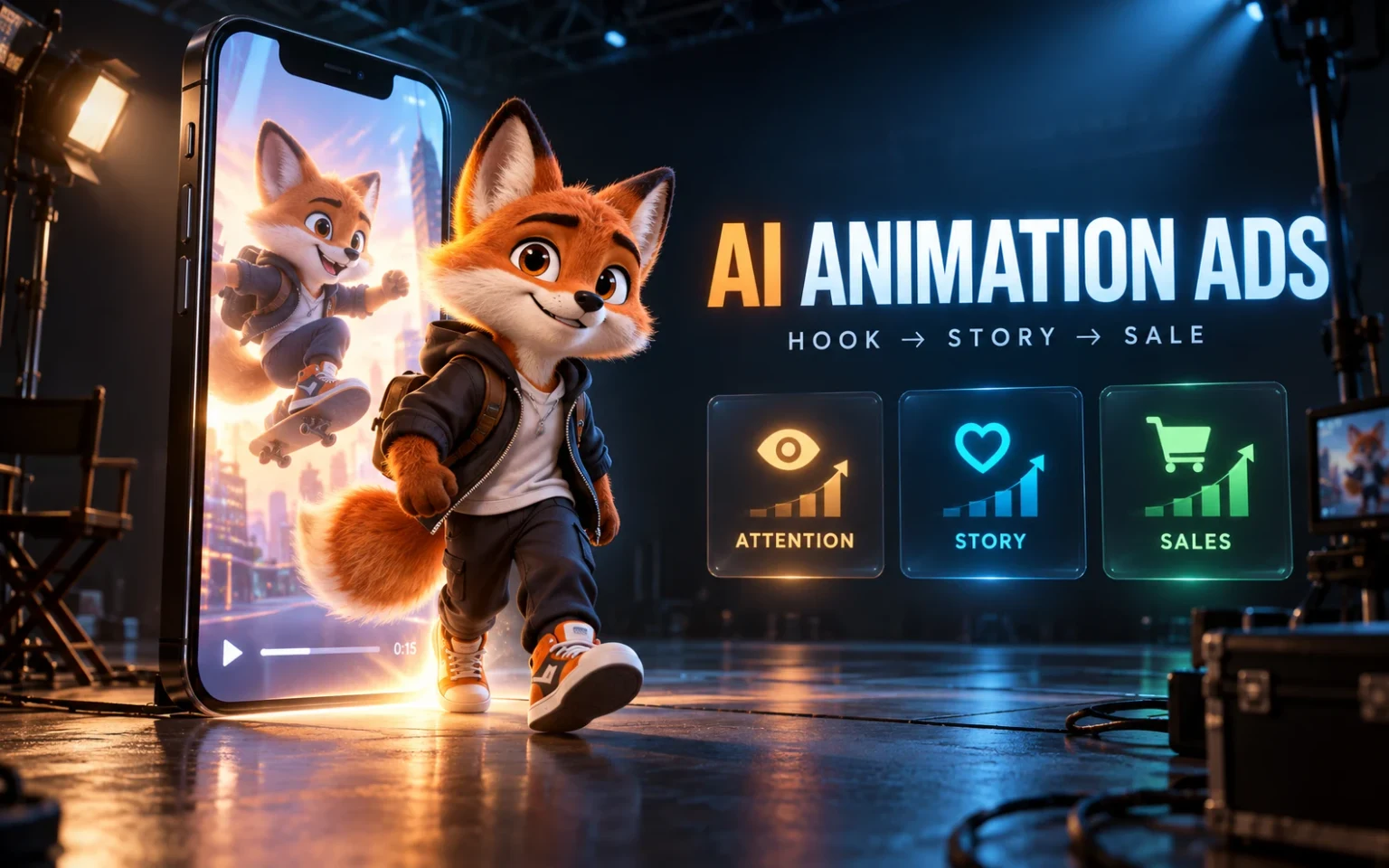
How I Make $20k/Month With Pixar Animations
Watch the original post and video on X
AI animation ads do not sell merely because they resemble a polished film. They work when animation serves a creative strategy: stop the scroll with a relevant hook, make the pain and transformation easy to understand, show product truth and proof early, and end with a measurable CTA. The source author's $20K-per-month claim is self-reported, not a guaranteed or independently verified outcome. Measure your own cost per approved creative, CPA and sales.
- The $20K-per-month and $300–$500-per-ad figures are the author's claims, not verified benchmarks
- Sell the outcome—hook, story, product truth and CTA—not the phrase Pixar-style
- Use a character bible and shot system to control identity, color, wardrobe and product continuity
- Test a 3 Hooks × 2 Proofs × 2 CTAs creative matrix instead of betting on one masterpiece
- Create original characters and visual language; do not imitate protected characters, logos or studio trade dress
- Connect Pixel/Conversions API and CRM feedback so the winner is judged by leads or purchases, not views alone
What the source reports—and what remains unverified
Pounds describes two main uses for AI animation: creative production and strategy for brands, plus consulting for SaaS and creative teams. The article reports roughly $20K per month, $300–$500 per ad and performance-linked fees in some engagements, and also describes paid and organic affiliate models used by other creators.
Those figures are self-reported in an X article. We did not review accounts, platform statements or independent evidence that verifies them. Treat them as examples of possible business models, not an automatic income outcome.
Why 3D storytelling can stop the scroll
Animation lets a brand construct characters, worlds and transformations that would be expensive or impossible to film. Novelty fades, however. The durable advantage is a story in which the customer recognizes a real problem, desire, tension and outcome.
TikTok recommends a Hook → Body → Close structure and early communication of value. Start with the message and audience moment—not the model picker.
- Hook: an unexpected image or event that remains relevant to the product
- Story: make the pain and desired transformation visible
- Proof: demo, data, testimonial or a verifiable mechanism
- Sale: one clear CTA that matches the landing page
An eight-step production system
- 1. Product truth — document the problem, evidence, limitations and prohibited claims
- 2. ICP moment — select the real moment when the audience feels the pain most strongly
- 3. Hook matrix — draft surprise, problem, transformation and curiosity openings
- 4. Character bible — lock proportions, face, wardrobe, palette, personality, voice and negative constraints
- 5. Storyboard — define five to eight shots, camera, movement, dialogue and product visibility
- 6. Generate small — approve keyframes and an animatic before long or high-cost renders
- 7. Edit for platform — 9:16, safe zones, captions, sound, logo and CTA
- 8. Review and export — check brand, claims, rights, continuity and tracking links
Turn one story into a measurable creative matrix
Do not spend the whole budget on one masterpiece. Keep the offer, audience and landing page stable while changing controlled variables. Three hooks × two proofs × two CTAs create twelve test cells from one narrative system.
- Hook: problem / outcome / unexpected moment
- Proof: product demonstration / customer result
- CTA: learn more / trial or booking
- Name versions such as EN-HOOK03-PROOF02-CTA01-V1
- Set minimum spend and stopping rules before launch
Four business models—not one magic tool
Pricing should reflect scope, revisions, usage duration, placements, source files and risk—not only video length.
- Creative service: concept, animation and variants with clearly defined usage rights
- Creative strategy retainer: weekly analysis, briefs and a new test matrix
- Performance arrangement: production fee plus an incentive with explicit attribution and caps
- Owned media or affiliate: build distribution while following disclosure and platform policies
Pixar-style may describe search intent, but it should not replace a brand
People use Pixar-style as shorthand for cinematic 3D animation. Commercial work should instead create original characters, names, worlds, palettes and visual language. Avoid protected characters, marks, logos or elements that imply a studio partnership.
The U.S. Copyright Office explains that protection for AI-containing work depends on sufficient human-authored expressive elements. Retaining briefs, sketches, selections, edits and final assembly improves both quality control and process evidence.
Measure creative that sells—not creative that only goes viral
AI can summarize ROAS, CPM, CTR, frequency and conversion quality and propose the next action plan. Budget changes, pauses and publishing should still pass human approval and an audit log.
- Attention: two-second hold, six-second views and thumb-stop rate
- Message: completion, saves and intent-rich comments
- Traffic: CTR and landing-page engagement
- Conversion: lead, registration, purchase and qualified revenue
- Economics: cost per approved creative, CPA, contribution margin and payback
Build a reusable production workflow with Claude and AI video
OG Solution's ChatGPT Work × Claude Cowork workshop covers brief decomposition, skills, connected tools, automation and reusable video workflows. Participants can begin with an internal workflow without having to build a web app.
Explore the ChatGPT Work × Claude Cowork workshopFrequently asked questions
What is an AI animation ad?
It is an advertisement in which generative AI helps create characters, environments, voices or motion, assembled into a story with a hook, product message, proof and CTA.
Does the video need to look like Pixar to sell?
No. Visual quality can earn attention, but sales depend on the offer, message, proof, distribution and tracking. Build an original visual identity.
Is the source author's $20K monthly income verified?
No. It is self-reported in the X article. We use it to examine business models, not to promise an outcome.
Which tools should I use?
Choose by job—script and storyboard, keyframes, animation, voice and editing. Compare cost per approved output and commercial terms rather than model names alone.
How do I keep a character consistent across shots?
Use a character bible, multi-angle references, seed or identity controls when available, prompt templates, negative constraints and a continuity review before animation.
How many creatives should I test first?
Begin with one story and a small matrix such as three hooks × two proofs × two CTAs, with predefined minimum spend and stopping rules.
Sources
- [1] How I Make $20k/Month With Pixar Animations — Pounds on X · accessed 2026-09-28
- [2] Creative best practices for top-performing TikTok ads — TikTok for Business · accessed 2026-09-28
- [3] Copyright and Artificial Intelligence — U.S. Copyright Office · accessed 2026-09-28