GPT-6 Astra vs Sol vs Luna: Route Work for Quality, Speed and Cost
A practical guide to choosing GPT-6 Astra, Sol or Luna—and building model routing, escalation and QA around accepted business outcomes.
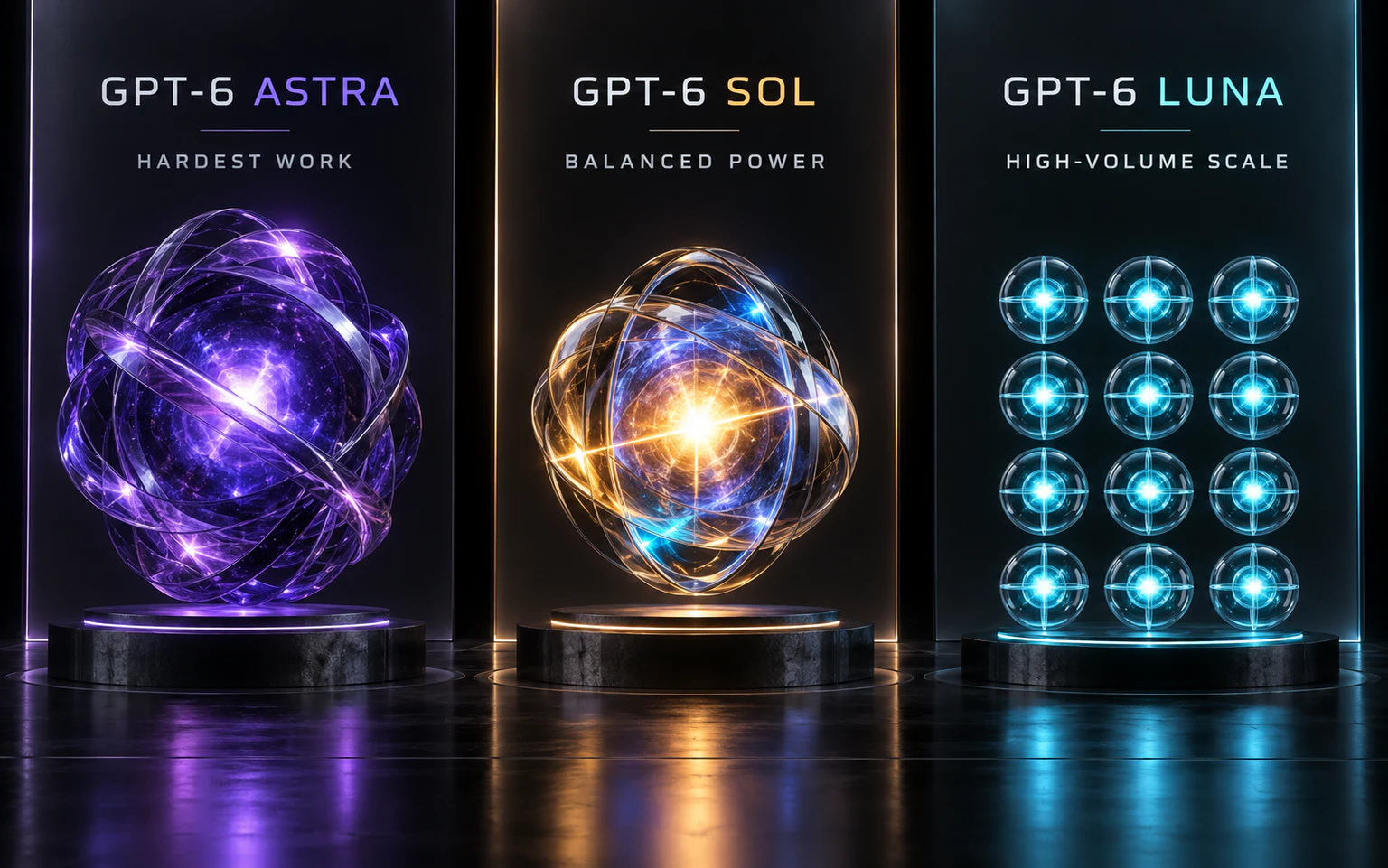
GPT-6 Sol and GPT-6 Luna launch announcement
Watch the original post and video on X
Use GPT-6 Astra for the hardest end-to-end reasoning and coding, GPT-6 Sol for a balance of capability and cost in complex coding and agentic workflows, and GPT-6 Luna for focused, high-volume, cost-sensitive work. A production system should route by task complexity and risk, verify the output, and escalate when confidence, tools, policy or QA fail—not send every request to the most expensive model.
- Astra targets the hardest work, Sol balances power and cost, and Luna targets focused high-volume work
- All three list large context and output limits, but their economics and best-fit workloads differ materially
- Start with the lowest-cost model that passes acceptance criteria
- Escalate on uncertainty, tool failure, policy risk or failed QA
- Measure cost per accepted outcome including retries, tools and review—not token price alone
The short answer: three workload tiers
OpenAI says Sol and Luna bring advances from Astra into faster and more affordable models, with more efficient caching and inference. The operational implication is that teams can stop using one premium model for every stage of a workflow.
- GPT-6 Astra: flagship reasoning and coding for the hardest end-to-end work
- GPT-6 Sol: balanced capability and price for complex coding and agentic production workflows
- GPT-6 Luna: efficient execution for focused, high-volume, cost-sensitive work
Read the full API economics
- Astra: $10 input and $50 output per 1M tokens on the comparison page reviewed September 28, 2026
- Sol: $2 input and $10 output per 1M tokens
- Luna: $0.10 input and $0.50 output per 1M tokens
- All three list a 1.05M-token context window and 128K maximum output
- Cached input, cache writes, Batch, Flex, Fast and regional processing have different economics
Route by task, not job title
Do not assume executive work always needs Astra. A routine executive-format conversion may suit Luna, while an apparently simple extraction can require Astra if the evidence is ambiguous and the cost of error is high.
- Luna: extraction, classification, tagging, format conversion and templated bulk variants
- Sol: coding agents, tool-using workflows, research synthesis, dashboard analysis and operations automation
- Astra: architecture, ambiguous strategy, high-stakes analysis, complex debugging and hard-case review
A production model-routing loop
- Classify task complexity, length, risk, tools and SLA
- Route clear volume work to Luna, multi-step work to Sol and hard/high-stakes work to Astra
- Verify with schemas, tests, citations and business rules
- Escalate when confidence is low, a tool fails, policy flags or QA fails
- Log task type, model, latency, tokens, retries, reviewer and pass/fail outcome
Optimize cost per accepted outcome
Use (input + output + cache writes + tool calls + retries + human review) divided by accepted outputs. A cheap model that needs repeated repair can cost more than Sol on the first pass; a highly templated job sent to Astra can waste money without improving acceptance.
Build an evaluation set from 30–100 real easy, medium, hard and high-risk cases. Test all candidates against the same acceptance criteria before setting routing policy.
Guardrails for a multi-model system
- Do not let the model choose an unlimited budget for itself
- Require approval for money, customer data, deployment or publication
- Record model/version and sources for decision-relevant outputs
- Run regression tests when changing model aliases, prompts, tools or policy
- Set timeouts, retry caps, cost caps and a manual fallback
Build a workflow that knows when to use each model
Our ChatGPT Work × Claude Cowork workshop teaches teams to decompose work, build skills and agents, connect data, schedule jobs and add human approval. You can begin with back-office work in Sheets, Docs, Slides and CRM without first building a web app.
The goal is not merely calling an API. It is selecting the smallest capable model for each step while keeping the outcome measurable and reviewable.
Explore the ChatGPT Work × Claude Cowork workshopFrequently asked questions
How do GPT-6 Astra, Sol and Luna differ?
Astra targets the hardest work, Sol balances capability and cost for coding and agents, and Luna targets focused high-volume workloads.
Which is cheapest?
On OpenAI's model comparison reviewed September 28, 2026, Luna has the lowest standard token price. Real cost still includes retries, tools and review.
Should every workflow begin with Luna?
No. Ambiguous or high-risk work may be cheaper overall on Sol or Astra. High-volume systems should still test whether Luna meets acceptance criteria.
Do all three support tools?
OpenAI's Models pages list major tools such as functions, web search, file search and computer use. Check each model and endpoint before implementation.
Does model routing require code?
A full API router usually does, but teams can validate task tiers and QA with manual or no-code workflows before engineering the router.
Sources
- [1] Models — choosing GPT-6 Astra, Sol and Luna — OpenAI Developers · accessed 2026-09-28
- [2] Compare GPT-6 models — OpenAI Developers · accessed 2026-09-28
- [3] GPT-6 Sol model — OpenAI Developers · accessed 2026-09-28
- [4] GPT-6 Sol and Luna announcement — OpenAI on X · accessed 2026-09-28