Astra for Law Explained: GPT-6 Legal Research with Human Judgment
A practical, evidence-based guide to OpenAI's Astra for Law: legal search, argument testing, plugins, access limits and governance for professional legal work.
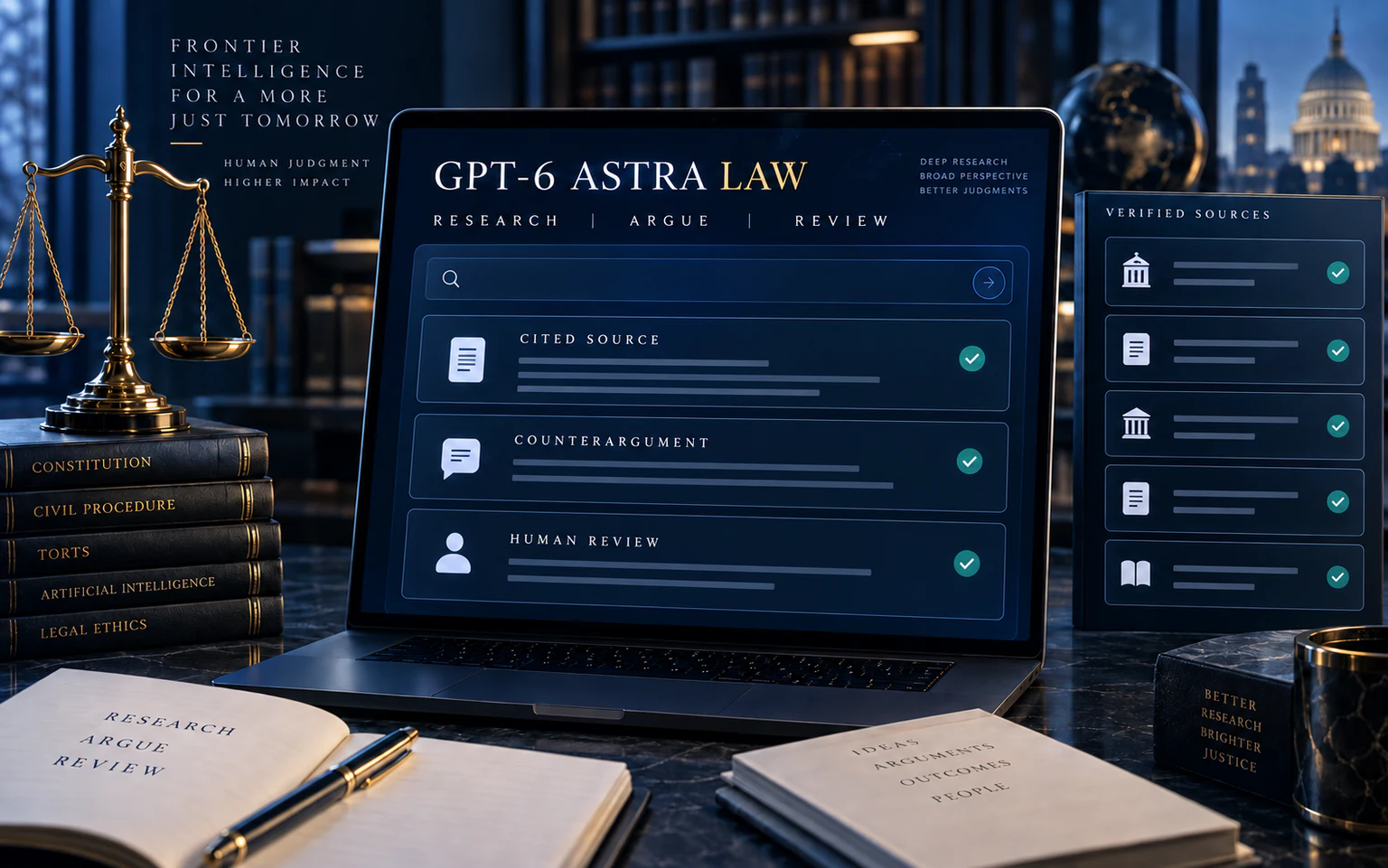
Astra for Law announcement
Watch the original post and video on X
Astra for Law is GPT-6 Astra tailored by OpenAI for professional legal work, combining a dedicated Legal Search Index with instructions for legal analysis and writing. It can research questions from client facts, develop arguments and terms, surface strong objections and analyze risk allocation. Initial access is for selected U.S. law firms and the search index covers U.S. legal sources; users must review every answer and cited source before relying on it.
- Astra for Law is a domain-specific professional model, not a general chatbot with a legal persona
- Its Legal Search Index covers specified U.S. legal sources and is updated daily
- Initial access is for selected U.S. firms through Trusted Access and Codex, with API access described as coming later
- AI can research, map arguments and draft, but lawyers must verify citations, jurisdiction, privilege and final judgment
- Organizations outside the U.S. should not assume local-law coverage or general availability
What makes Astra for Law different
OpenAI describes Astra for Law as GPT-6 Astra combined with a Legal Search Index and custom instructions for legal analysis and writing. The differentiator is specialized retrieval, professional context and a lawyer-review workflow—not merely a system prompt that sounds legal.
The product is designed to test a position as well as support it: finding cases that weaken an argument or explaining how a contractual exception changes risk allocation. That is more useful than generating confident prose that confirms the user's initial view.
What the Legal Search Index covers—and what it does not prove
- OpenAI lists U.S. case law, statutes, regulations, court rules and administrative decisions
- The index is updated with new sources daily according to the Help Center
- Cited sources should be opened and reviewed in their original form
- The announcement does not establish coverage for Thai law, every jurisdiction or every commercial database
- A citation still requires validation for accuracy, authority and current status
A legal workflow that preserves professional judgment
- Separate client facts, assumptions and legal questions
- Define jurisdiction, the as-of date and acceptable authority types
- Generate an issue list and research plan before conclusions
- Search both supporting and adverse authority
- Build an argument map with uncertainty and unresolved issues
- Open every citation and check subsequent history
- Require the responsible lawyer to revise, approve and own the final work
Plugins connect research to matter workflow
OpenAI gives partner examples such as iManage for saving a negotiation brief back to a matter file and DeepJudge for bringing prior deals into a comparison. The Help Center also mentions community skills built by lawyers and legal engineers.
That removes manual copying but adds permission and data-handling risk. Firms should review authorization scope, logging, retention, vendor terms and every action that can write back to a matter system.
Eight governance controls for law firms
- Eligibility and supervision by qualified lawyers
- Attorney-client privilege and document confidentiality
- Conflict checks before combining matter data
- Jurisdiction and authority dates
- Citation verification and subsequent-history review
- Human approval before client delivery, filing or binding terms
- Audit records for sources, model, plugins and reviewer
- Retention, access removal and incident response
Who can access it, and what international teams can do now
OpenAI says initial access is for selected U.S. law firms through Trusted Access and Codex, for eligible lawyers and people working under their supervision, with API availability planned later. A launch announcement therefore does not mean it is open to every account or jurisdiction.
International teams can prepare now by defining data classification, approved sources, research templates, citation QA and human approval. That foundation lets the organization evaluate a future locally relevant model without inventing governance during the pilot.
Train teams to use AI with verifiable controls
The same pattern applies to any high-stakes workflow: let AI research and draft, require citations and counterarguments, and pause for expert approval. Our ChatGPT Work × Claude Cowork workshop helps organizations design skills, connectors, document workflows and approval gates around real work.
For a custom implementation, OG Solution starts with the business risk, data boundary and owner—not with the model currently attracting attention.
Explore the ChatGPT Work × Claude Cowork workshopFrequently asked questions
What is Astra for Law?
It is GPT-6 Astra tailored for professional legal work, combining a dedicated Legal Search Index with instructions for legal research, analysis and writing.
Does Astra for Law cover Thai law?
The official materials reviewed specify U.S. legal sources and do not confirm Thai-law coverage. Do not use it as a substitute for Thai legal databases or qualified Thai counsel.
Who can use Astra for Law?
OpenAI says initial access is for selected U.S. law firms through Trusted Access and Codex, for eligible lawyers and people working under their supervision.
Will Astra for Law have an API?
The Help Center says API access is coming later. Verify current access and commercial terms with OpenAI.
Does it replace a lawyer?
No. OpenAI instructs users to review answers and cited sources, and legal work still requires expert judgment, supervision and accountability.
What are the main risks?
Incorrect or incomplete citations, wrong jurisdiction, disclosure of privileged data, over-broad plugin access, missed conflicts and using drafts without qualified review.
Sources
- [1] Astra for Law — OpenAI Help Center · accessed 2026-09-28
- [2] Astra for Law announcement — OpenAI on X · accessed 2026-09-28