Did Sam Altman Say He Runs Hundreds of AI Agents Every Night? Source Check and Loop Guide
A source-checked response to a viral GPT-6 Astra claim, plus a practical Loop → Verify → Report architecture for safe overnight AI agents.
Viral claim about Sam Altman and overnight AI agents
Watch the original post and video on X
Do not attribute the claim about hundreds of GPT-6 Astra agents running every night to Sam Altman based on this post. The traceable interview is with Boris Cherny, creator of Claude Code, who described several hundred agents running generally and several thousand doing deeper work at night through sub-agents and loops. The viral post appears to mix the speaker, product and numbers.
- The source post is third-party commentary, not an OpenAI or Sam Altman account
- The traceable interview points to Boris Cherny and Claude Code—not GPT-6 Astra
- The reported numbers are hundreds generally and thousands at night
- The useful lesson is a loop with stop criteria, verification, permissions and budgets
- Begin with read-only, machine-verifiable tasks before allowing writes, sends or payments
Verdict: a real operating pattern with unsupported attribution
The Sanskriti Naruka post names Sam Altman, GPT-6 Astra and hundreds of agents running every night, but it does not link a transcript or primary OpenAI source for that wording. In the official and primary sources reviewed on September 28, 2026, we did not find support for that attribution.
The traceable interview is Boris Cherny, creator of Claude Code, on Sequoia's Training Data. He described five to ten sessions, several hundred agents running, and several thousand doing deeper work at night, using sub-agents and loops.
What survives the source check
- Supported: a public interview discusses many concurrent agents and overnight work
- Wrong speaker: the traceable source is Boris Cherny, not Sam Altman
- Wrong product context: the interview concerns Claude Code loops and sub-agents, not GPT-6 Astra
- Changed number: the source reports hundreds generally and thousands at night
- Unsupported combination: the 'no longer need prompts' line is not established as the same quote in the reviewed source
Loop engineering in business language
Claude defines a loop as an agent repeating cycles of work until a stop condition is met. Loops differ by trigger, stopping rule and primitive. The important variable is not agent count; it is whether done, budget and verification are explicit.
A business loop can run every thirty minutes, nightly or weekly: check unanswered leads, summarize a dashboard, test changed pages, cluster feedback or prepare a reviewable report without first building a web app.
- Trigger by time, event or data change
- Observe only authorized sources
- Act within a narrow scope
- Verify with an independent rule, test or agent
- Stop or escalate on uncertainty and limits
- Report evidence, failures, cost and pending approvals
Good first overnight jobs
- Check changed URLs for HTTP status and expected headlines without editing production
- Read ads, analytics and CRM data and report anomalies with sources
- Find leads outside the response SLA and prepare unsent follow-up drafts
- Cluster comments, reviews and sales calls into pains, objections and intent
- Run CI, tests or data-quality checks with clear pass/fail results
- Prepare a permission-scoped morning brief from calendar, inbox and project status
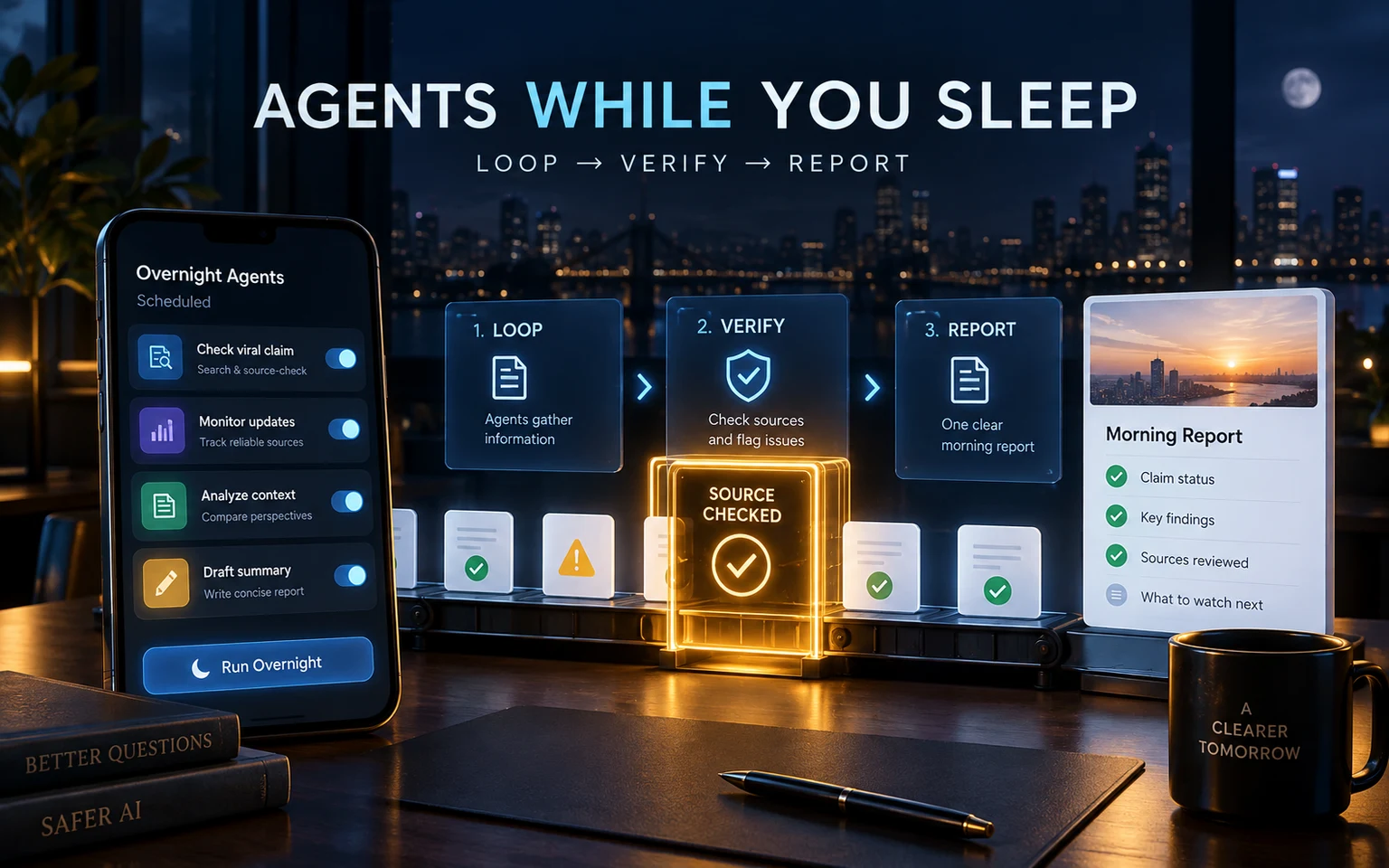
An overnight architecture you can trust
- A scheduler matches task frequency to how often the underlying data changes
- A maker agent works in a sandbox with least privilege
- A separate verifier checks sources, schemas, tests and business rules
- Budget caps limit tokens, tools, retries, duration and parallel agents
- Checkpoints allow safe resume instead of repeating the whole run
- A kill switch and human approval guard publish, payment, deletion and customer messaging
- A morning report shows pass/fail, evidence, cost and decisions needed
Do not optimize for agent count
One thousand agents create no business value if they reread the same context, duplicate work or lack a verifier. Measure cost per accepted outcome: model, cache, tools, retries, review and incident cost divided by work that passes and gets used.
Start with one loop, one owner, one KPI and a small evaluation set. Expand write access or parallelism only after the reports have been reliably boring for multiple runs.
Build a digital workforce from real work, not a viral number
OG Solution's ChatGPT Work × Claude Cowork workshop covers skills, connectors, schedules, Google Sheets/Docs/Slides, Claude Code, GitHub and human approval. Participants can build daily workflows even when they do not want a web app.
For organizations, our private consulting starts with process, permissions, tracking and KPIs before selecting the tools or number of agents.
Explore the ChatGPT Work × Claude Cowork workshopFrequently asked questions
Did Sam Altman say he runs hundreds of AI agents every night?
We did not find a primary OpenAI source supporting that attribution. The traceable similar statement is from Boris Cherny, creator of Claude Code.
What numbers did Boris Cherny report?
Published transcripts report five to ten sessions, several hundred agents running, and several thousand doing deeper work at night.
How is a loop different from a scheduled task?
A schedule triggers work at a time. A loop repeats agent cycles until a stop condition, usually with verification and escalation.
Can a non-technical business use overnight agents?
Yes. Start with read-only reporting, lead-SLA checks, feedback clustering, drafts and morning briefs across approved business tools.
Should an overnight agent send emails or change ad budgets?
Not at first. Let it prepare a draft or recommendation and require human approval until evaluation, auditing and rollback are proven.
Do I need hundreds of agents?
No. Most teams should begin with one loop and optimize accepted outcomes and saved review time—not agent count.
Sources
- [1] Viral claim about Sam Altman and overnight agents — Sanskriti Naruka on X · accessed 2026-09-28
- [2] Anthropic's Boris Cherny: Coding's Printing Press Moment — Training Data / Sequoia Capital · accessed 2026-09-28
- [3] Loop engineering: Getting started with loops — Claude by Anthropic · accessed 2026-09-28
- [4] Measurements for understanding the pace of AI development inside frontier labs — Anthropic · accessed 2026-09-28